


Biosorption of Cr(VI) from Aqueous Solution Using Excess Municipal Sludge
Abstract 1Medical University of Isfahan, Iran 2Department of civil engineering, Isfahan University of Technology, Iran For correspondence: Email: rahimi.somaye@gmail.com
Keywords Hexavalent Chromium; Biosolid; Biosorption; Wastewater; Industrial
Copy the following to cite this URL:
https://yourjournal.com/article/xyz123
Introduction:
Introduction
The increase in usage of heavy metal in industrial activities has caused the existence of them in wastewater (Innocent et al., 2009). Heavy metal contamination of industrial effluents is one of the significant environmental problems due to toxic nature and accumulation throughout the food chain as non-biodegradable pollutants (Abdullah et al., 2009). Most of the heavy metal salt are soluble in water and from aqueous solutions and consequently cannot be separated by ordinary physical means of separation. Physico-chemical methods such as chemical precipitation, chemical oxidation or reduction, electrochemical treatment, evaporative recovery, filtration, Ion exchange, and membrane technologies have been widely used to remove heavy metal Ions from industrial wastewater (Hussein et al., 2004). the pollutant of concern include lead, chromium, mercury, uranium, selenium, zinc, arsenic, cadmium, gold, silver, copper and nickel (Ahalya et al., 2003).
Chromium is a chemical element which has the symbol Cr and atomic number 24. It is a steely-gray, lustrous, hard metal that takes a high polish and has a high melting point. Chromium was regarded with great interest because of its high corrosion resistance and hardness (Bhadeshia., 2009).
Chromium is one of such metals which have long been used in electroplating, leather tanning, metal finishing and chromate manufacturing industries. Chromium is a contaminant existing in hexavalent and trivalent forms. The hexavalent form is more toxic than the trivalent form and is thus of more concern. Strong exposure to Cr (VI) causes cancer in the digestive tract and lungs, epigastria pain, nausea, vomiting, severe diarrheal and haemorrhage. It is therefore essential to remove Cr (VI) from wastewater before disposal. (Ozdemir et al., 2004). The concentrations range, in sea water is 5 to 800 µg/liter, and in rivers and lakes 26 µg/liter to 5.2 mg/liter (KotaÅ› et al., 2000).
the application of Traditional removal methods has been found to be sometimes restricted, because of expensive investment, operational costs and the potential generation of secondary pollution. Furthermore such processes may be ineffective or extremely expensive when the initial heavy metal concentrations are in the range of 10-100 mg/L (Venkata et al., 2008).
Therefore, there is a need for a cost effective treatment method that is capable of removing low concentrations of zinc from solution. Biological materials are known for their potential to adsorb heavy metals (Norton et al., 2004).
Of the different biological methods, bioaccumulation and biosorption have been demonstrated to possess good potential to replace conventional methods for the removal of metals. Herein, therefore, bioaccumulation is defined as the phenomenon of living cells; whereas, biosorption mechanisms are based on the use of dead biomass. To be precise, bioaccumulation can be defined as the uptake of toxicants by living cells; biosorption can be defined as the passive uptake of toxicants by dead/inactive biological materials or by materials derived from biological sources (Vijayaraghavan et al., 2008). Non-living biosorbents provide the following advantages:
- Harsher reaction environments may be employed;
- The need for an additional nutrient supply is negated;
- Sudden death of the biomass population can be avoided;
- Regeneration with a suitable eluent allows biosorbent reuse; and
- It can be immobilized in a matrix and used in conventional ion exchange systems (Norton et al., 2004).
There are many mechanisms those are responsible for biosorption, which may be one or combination of ion exchange, complexation, coordination, adsorption, electrostatic interaction, chelation and microprecipitation (Vijayaraghavan et al., 2008).
In this paper, the removal of chromium from aqueous solutions by excess municipal sludge was investigated in batch experiments. The objectives of this study include identifying the maximum theoretical chromium uptake capacity of the sludge, determining the reaction kinetics and evaluating the initial metal concentration, initial pH, agitation speed, adsorbent dosage and agitation time on chromium uptake.
Materials and Methods
Preparation of Biosorbent: Excess municipal sludge from the Isfahan Wastewater Treatment plant, was collected for use as a biosorbent. This treatment plant was chosen because the wastewater treated is of domestic origin with low background concentrations of chromium. In this place Excess municipal sludge is produced about 100 tons in 24 hours. The Sludge was dried at 103 C° until constant weight to form the dry unground biosolids and were grounded for pretreatment. The sludge was sieved for a particle size of 150μm and was used as biosorbent. This was to allow for shorter diffusion path, thus allowing the adsorbate to penetrate deeper into the effluent more quickly, resulting in a higher rate of adsorption (Adeyinka et al., 2007).
Chemical Materials
Chromium solutions were prepared according to ‘Standard Methods’ (Standard methods., 1998).Distilled water was used for all solutions. Chromium Standard 1000 mg/l solution was prepared by dissolving 2.829 gr of potassium dichromate (k2 Cr2 O7) in distilled water. Stock solution was diluted for preparation of other concentration. NaOH and HCl solutions were used for pH adjustment. The cells was washed with distilled water and 5% H2SO4 solution several times to remove foreign matter.
Experimental Equipment
In this study was used of glassware cells like pipette and balloon and also was used of 0.45-μm membrane filter and atomic adsorption spectrophotometry (HACK DR2010) and shaker (Rotator R430) and pHmeter (3045 Ion Analyzer) and other equipment in environmental lab of Isfahan university of technology.
Experimental Procedure
Batch biosorption experiments were conducted until equilibrium was reached. Equilibrium was deemed to have been reached when no further metal removal occurred. Various concentration of Cr (VI) solution was prepared by diluting stock solution. Then pH was calibrated with buffer solutions at pH 4 and 7 prior to use. For experiments with controlled pH, either NaOH or HCl solutions were used for pH adjustment. Then 25 ml samples were prepared in defined concentration and dry biosorbents was added to samples. All experiments were at least conducted in duplicate with the average presented in the results Therefor 296 experiments should be done for this study. Experiments were conducted in lab temperature (2±25 C°). The solution was placed on an shaker and mixed in 120 minutes at 200 rpm until equilibrium was reached. The biosorbents were removed by filtration through a 0.45-μm membrane filter (Millipore). Residual concentration of chromium in the samples was estimated according to standard number 3500 of standard methods book (Standard methods., 1998) by colorimetric method using an atomic adsorption spectrophotometer in 540 nm wavelength. Chroma Ver 3 Chromium Reagent Powder Pillows was purchased as reagent.
Agitation Speed Optimization Experiments
The experiments were conducted in full factorial design. For decreasing the number of experiments agitation speed was separated from other parameters and with some separated experiments agitation speed was optimized. The optimum rate was used in all of full factorial design experiments. The samples was prepared with solutions of initial concentrations of 5, 20, 50, 90 mg/lit, The pH of the solutions at the start of the experiment was 4, adsorbent dosage was 8 g/lit and different agitation speed ranging from 50 to 200 rpm and The samples were shaken for the period of 120 minutes.
Kinetic Experiments
Cr solution concentrations of 5, 20, 50 and 90 mg/lit were used in agitation times of 5, 15, 30, 60, 120, 180, 300 and 480 minutes were investigated. 25 ml samples of solution were prepared in adsorbent dosage of 8 gr/lit. An agitation speed of 200 rpm and pH 4 was used for this set of experiments.
Sorption Parameters Optimization Experiments
In order to optimization of chromium (VI) removal, initial concentration, pH and adsorbent dosage were investigated. Initial concentration ranging from 5 to 90 mg/lit and pH ranging from 2 to 8 and adsorbent dosage ranging from 2 to 10 g/lit was selected.
Isotherm Experiments
Batch equilibrium studies were conducted with biosorbent excess municipal sludge contacted with various concentration of Cr (VI) solution (5-90 mg/L) at pH 4 with contact time (120 min). The reaction mixtures were agitated on a rotary shaker at 200 rpm and the adsorbate dosage was 2, 4, 6, 8 and 10 g/lit.
Result and Discussion
Kinetic Studies
Chromium kinetic adsorption was shown in figure 1 in different initial concentration. Increase in agitation time generally increases the amount of biosorbed metal ions. After reaching to equilibrium time the percentage biosorption would be fixed. The time that was adequate to ensure equilibrium between chromium adsorbed and chromium unadsorbed was named equilibrium time (Perry et al., 1997) therefor equilibrium time for Cr(VI) solution was equal to 120 minutes. Fig.1 shows that, biosorption process could be divided in to tree stages; first one is fast stage, next one is middle stage and last one is slow stag. Fast stage was finished after 30 minutes in four tested concentration, in 5 mg/lit solution concentration, Cr removal percentage was 51.76% after 30 minutes and finally in 90 mg/lit solution concentration, Cr removal percentage was 59.36%. it could be seen that increasing in initial concentration, increase biosorption rate in certain time. These results were adopted with Quintelas and et.al results. They work on Biosorption of Cr (VI) by three different bacterial species. Their studies show that Cr removal percentage was between 50 to 60% in first 30 minutes (Quintelas et al., 2008). After fast stage, biosorption rate decrease and it continue until equilibrium time. Middle stage last about 90 minutes and after it removal rate would be slower and increase in slightly slope, this period of biosorption was known as slow stage.
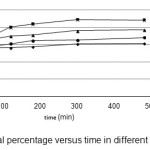 |
Figure1: Cr Removal percentage versus time in different initial concentrationClick here to View figure |
In order to investigate the mechanism of sorption and potential rate controlling steps such as mass transport and chemical reaction processes, kinetic models have been used to test experimental data. These kinetic models included the first order equation, the second order equation and the Elovich equation. Lagergren pseudo-first order model takes the form,

after integration between (t=t,t=0) and (q=q0,q=0) linear equation would be:

Where qe, qt are amount of metal ion adsorbed per unit mass of an adsorbent at equilibrium and at time t (min). k1 is the first order rate constant of adsorption. The linear plots of time t versus log (qe- qt ) at different concentrations indicate the applicability of the equation(ubeyde and etal, 2009) Kinetic data were further treated with pseudo second-order kinetic model. The differential equation is as follows:

after integration between (t=t,t=0) and (q=q0,q=0) linear equation would be:

where k2 is the equilibrium rate constant of pseudo second-order adsorption (gmg−1min−1). If pseudo second-order kinetics is applicable, the plot of t/qt versus t should show a linear relationship at different initial metal ion concentrations (ubeyde et al., 2009).
The Elovich equation is generally expressed as follows:

Where qt is the sorption capacity at time t (mg g-1), α is the initial sorption rate (mg g-1 min-1) and β is the desorption constant (gmg-1) during any one experiment. To simplify the Elovich equation, and by applying the boundary conditions between (t=t,t=0) and (q=q0,q=0) equation (5) becomes:

Thus, the constants can be obtained from the slope and the intercept of a straight line plot of qt against ln(t). Equation (6) will be used to test the applicability of the Elovich equation to the kinetics of sorption (HO et al., 1998).
The correlation coefficients (R2) for the second-order rate kinetic model are higher than 0.99. These indicate that the adsorption of Cr (VI) from aqueous solution on excess municipal sludge obeys pseudo second-order kinetic model. After it results was more adopted with Elovich equation. Constants and correlation coefficients (R2) for the all of mentioned models was shown in table 1.
The results of the present study are in agreement with the work of Venkata Subbaiah and et al (Venkata et al., 2008).
Table1: kinetic models constants
|
Elovich |
Second order |
First order |
model |
||||||
|
R² |
α |
qe (mg/g) (1/β) |
R² |
k2 |
qe (mg/g) |
R² |
k1 |
qe (mg/g) |
C0 |
|
0.813 |
0.15 |
0.07 |
0.997 |
0.14 |
0.40 |
0.784 |
.00690 |
0.13 |
5 |
|
0.857 |
0.093 |
0.26 |
0.999 |
0.043 |
1.74 |
0.764 |
.00460 |
2.65 |
20 |
|
0.909 |
0.045 |
0.71 |
0.999 |
0.016 |
4.95 |
0.905 |
.00690 |
1.80 |
50 |
|
0.974 |
0.096 |
1.20 |
0.999 |
0.007 |
10.31 |
0.841 |
.00690 |
3.72 |
90 |
Adsorption isotherm: Cr equilibrium isotherm graph is seen in Fig.2 and its upward convexity shows graph desirability during biosorption, a rapid equilibrium is reached between the adsorbed metal ion on the biosorbent and the metal ions found in the solution. The sorption isotherm is representative of the distribution of the solute in the solid phase and in the liquid phase at equilibrium. Several models have been developed to describe adsorption isotherms. The present study focused on three widely used sorption models: the Langmuir, the Freundlich and the BET models.
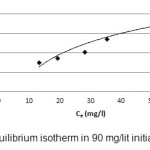 |
Figure2: Cr equilibrium isotherm in 90 mg/lit initial concentration |
The values of Langmuir's q (metal uptake of species or adsorption capacity (mg/g)), qmax or b (maximum metal uptake or maximum adsorption capacity (mg/g)), Cf (solute equilibrium concentration (mg/L)) and a (is a constant related to energy of adsorption (l/mg)) can be derived from a Linearization by Plotting 1/qe Versus 1/Ce Equation (7) is often expressed as (Perry et al., 1997):

Freundlich is Next model is tested. The Freundlich equation is often linearized by logarithmic transfer of equation. (8):

Where q = amount of solute per unit dry weight of sorbent, (mg/ g), Ce = solute equilibrium concentration (mg/L), k and l/n = empirically determined constants. Thus, a plot of In (qe) versus (Ce) should give a straight line, from the intercept of which k may be estimated and from the slope of which 1/n may be calculated. k is related to the adsorption capacity and l/n indicates the adsorption intensity (Perry et al., 1997).
BET is the last model is tested. The BET equation is often linearized as equation. (9):

Where Cs is the saturation concentration (solubility limit) (mg/L) of the solute, A is a constant related to the energy of adsorption and Xm (mg/g) is the amount of solute needed to form a complete unimolecular adsorbed layer.
Which shows that a plot of Ce / qe (Cs - Ce) against Ce / Cs should give a straight line whose Intercept is1/AXm and whose slope is (A-1)/AXm. The two constants A and Xm can be evaluated from the slope and the intercept.
In all cases, the adsorption was found to follow Freundlich adsorption isotherm and after it Langmuir isotherm has agreement with data. The corresponding parameters for the each adsorption isotherm model are summarized in Table 2. The last column of each model in Table 2 indicates the R2 obtained from the fitting of experimental data to the isotherm. Maximum chromium adsorption capacity of Excess municipal sludge (qmax) was estimated at 41/69 mg Cr/gr biosorbent in optimum condition.
Izabela Michalak et al (2007) show that biosorption of Cr follow Langmuir isotherm (Michalak., 2007).
Table2: Isotherm models constants
|
BET isotherm |
Freundlich isotherm |
Langmuir isotherm |
|||||||||
|
R² |
A |
Xm |
C0 |
R² |
n |
Kf |
C0 |
R² |
a |
b |
C0 |
|
723.0 |
430.- |
000520.- |
5 |
0.969 |
0.211 |
11.21 |
5 |
944.0 |
32.0 |
00020.0 |
5 |
|
831.0 |
11.- |
0015.0- |
20 |
0.942 |
0.252 |
13.34 |
20 |
925.0 |
11.0 |
0010.0 |
20 |
|
823.0 |
16.82 |
003.0 |
50 |
0.960 |
0.835 |
8.936 |
50 |
958.0 |
009.0 |
020.0 |
50 |
|
984.0 |
27.98 |
0081.0 |
90 |
0.955 |
561. |
6.585 |
90 |
914.0 |
03.0 |
026.0 |
90 |
Effect of Agitation Speed on Adsorption
Cr adsorption rate versus agitation speed variety was presented in Fig3. The optimum speed in all concentration is 200 rpm. According to the graph effect of agitation speed in all concentration was equal and the removal rate increase about 20 to 25%. Lower metal uptake at the biosorption mixtures caused by vortex phenomenon. The highest uptake of chromium at an agitation speed of 200 rpm observed presently indicates least mass transfer resistance experienced by the system. Thus, it appears prudent to carry out biosorption at this speed and no further enhancement is needed to make the binding sites readily available for chromium uptake. It is known that external mass transfer resistance is directly proportional to the thickness of the stationary fluid layer surrounding the biomass particles. The film thickness in turn is controlled by the agitation speed of the bulk solution. A higher agitation speed decreases the film thickness and eventually eliminates film resistance (Parvathi et al., 2007). Similar trends in biosorption of cadmium and lead by Sargassum sp. have been reported by Cruz et al. (Cruz et al., 2004) and Martins et al. (Martins et al., 2013).
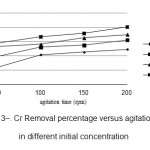 |
Figure3: Cr Removal percentage versus agitation time in different initial concentration |
Effect of Chromium Concentration
Biosorption increased with rise in chromium concentration in the solution (Fig. 4). A rise in chromium concentration from 5 to 90 mg/L resulted in an increase in Cr removal rate by Excess municipal sludge dosage in 4 g/l,pH 4, agitation speed 200 rpm and agitation time 5,120 and 480 minutes. Respectively. Similar performance by S. cerevisiae during studies on chromium biosorption from its synthetic aqueous solutions has been reported by Goyal et al. (Goyal et al., 2003).
Removal of chromium(VI) was highest at pH 2 and initial concentration 90 mg/l (96%), as evident from Fig. 5. The removal rate decreased to 60% at pH 8. The graphs plotted in 4 initial concentrations as you can see in the figure.
Cr (VI) is an anionic species in solution. The dominant hexavalent chromium species at acidic pH are HCrO4– and CrO4-2 at acidic pH, due to increased H+ ion concentration, the biosorbent becomes protonated. The increase in Cr (VI) biosorption at acidic pH may be attributed to the electrostatic attraction between positively charged groups of the protonated biosorbent and anionic species of chromium. Moreover, the fall in biosorption with increasing pH could be due to two reasons: one is the decrease of the electrostatic attraction and the second is the competition between the chromium anionic species and OH- ions for adsorption onto the binding sites of the biosorbent (Parvathi et al., 2007). Such a phenomenon for Cr (VI) biosorption has also been observed by Åžahin et al. (2005) and Zhou et al. (2007).
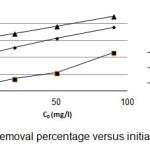 |
Figure4: Cr Removal percentage versus initial concentration |
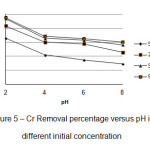 |
Figure5: Cr Removal percentage versus pH in different initial concentration |
Effect of adsorbent dosage on adsorption: As the biosorbent dose increases, the total removal of Cr(VI) will be attained fast and also the capacity of biosorbent for the removal of total chromium increases until reaching to optimum dosage. An increase in biomass dosage generally increases the amount of biosorbed metal ions because an increase in surface area of the biosorbent, which consequently increases the number of binding sites (Abdullah et al., 2009).
Fig6. Was presented adsorbent dosage versus Cr removal rate. It was illustrated from graphs that optimum dosage was 4 g/lit. as you can see increasing in dose after optimum dose decrease removal rate. This phenomenon appears because of increase contacts between solid phase that is lead to break the links between adsorbent and metal ions.
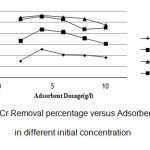 |
Figure6: Cr Removal percentage versus Adsorbent Dosage in different initial concentration |
Conclusions
Excess municipal sludge has been found to be efficient for the removal of Cr (VI) from aqueous solution. The study revealed that, the most important parameter in Cr removal is initial concentration and the pH of the solution is the next important parameter in the biosorption process. Cr (VI) was removed completely at lower pH due to biosorption coupled bioreduction processes. The maximum removal of total chromium was obtained at initial concentration 90 mg/lit and pH 2.0. The Freundlich and Langmuir isotherm model are fitted the equilibrium data. The kinetic data was well described by pseudo second order kinetic. The adsorption rate increases with an increase of biosorbent dosage until 4 g/lit. The findings of this study revealed that the Excess municipal sludge is a promising biosorbent for the removal of Cr (VI) from contaminated wastewater.
Acknowledgements
Environment Research Center, Isfahan University of Medical Science (IUMS) Isfahan, Iran; and Department of Environmental Health Engineering, School of Health, student, Research Center, (IUMS), Isfahan, Iran.
References
- Abdullah, M, A,. Devi Prasad, A,G.,Kinetic and Equilibrium Studies for the Biosorption of Cr(VI) from Aqueous Solutions by Potato Peel Waste. International Journal of Chemical Engineering Research. 1(2), 51–62 (2009).
- Adeyinka, A., Liang, H., Tina, G., Removal of Metal Ion form Waste Water with Natural Waste. School of Engineering and Technology, 3, 1-8 (2007).
- Ahalya,N., Ramachandra,T,V., Kanamadi,R,D., Biosorption of heavy metals. Research Journal Of Chemistry And Environment, 7 (4), 71-78 (2003).
- Bhadeshia, H, K, D, H., Nickel-Based Superalloys. University of Cambridge. http://www.msm.cam.ac.uk/phase-trans/2003/Superalloys/superalloys.html. Retrieved 2009-02-17.
- Cruz, C.C.V., da Costa, A.C.A., Henriques, C.A., an Luna, A.S., Kinetic modeling and equilibrium studies during cadmium biosorption by dead Sargassum sp. Biomass. Technol, 91, 249–257 (2004).
- Goyal, N., Jain, S.C., Banerjee, U.C., Comparative studies on themicrobial adsorption of heavy metals Adv. Res, 7, 311–319 (2003).
- HO, Y.S., Mckay,G., A comparison of chemisorptions kinetic models applied to pollutant removal on various sorbents. Trans IChemE, 76(Part B), 332-340 (1998).
- Hussein,H., Ibrahim, S, F., Kandeel, K., Moawad, H., Biosorption of heavy metals from waste water using Pseudomonas sp. Electronic Journal of Biotechnology.7 (1), 38-46 (2004).
- Innocent, O., Emmanuel, A., Thomas, A., Biosorption of Heavy Metal Ions from Aqueous Solutions Using a Biomaterial. Leonardo Journal of Sciences, 14, 58-65 (2009).
- KotaÅ›, J., Stasicka Z., Chromium occurrence in the environment and methods of its speciation. Environmental Pollution, 107 (3), 263–283 (2000).
- Martins, B.L., Cruz, C.C.V., Luna, A.S., Henriques, C.A., Sorption and desorption of Pb2þ ions by dead Sargassum sp. biomass. Eng. J, 27, 310–314 (2006).
- Michalak, I., Biosorption of Cr(III) by Microalgae and Macroalgae: Equilibrium of the Process. American Journal of Agricultural and Biological Sciences, 2(4), 284-290 (2007).
- Norton, L., Baskaran, K., McKenzie, T., Biosorption of zinc from aqueous solutions using biosolids. Advances in Environmental Research, 8, 629-635 (2004).
- Ozdemir, G., Baysal, S,H., Chromium and aluminum biosorption on Chryseomonas luteola TEM0. Appl Microbiol Biotechnol. 64, 599–603 (2004).
- Parvathi, K., Nagendran, R., Biosorption of Chromium from Effluent Generated in Chrome-Electroplating Unit using Saccharomyces cerevisiae. Separation Science and Technology, 42, 625–638 (2007).
- Perry, R.H., Green, D., Perry’s,Chemical Engineer’s Handbook, 7th Edition, McGraw-Hill, International Edition (1997).
- Quintelas, C., Fernandes, B., Castro, J., Biosorption of Cr(VI) by three different bacterial species supported on granular activated carbon—A comparative study. Journal of Hazardous material, 153799–809 (2008).
- Åžahin Y, Öztürk. A., Biosorption of chromium(VI) ions from aqueous solution by the bacterium Bacillus thuringiensis. Process Biochem,40, 901-1895 (2005).
- Standard methods for examination of water and wastewater, American public health association (1998).
- ubeyde Baysal, Z., Ercan, C., Bulut, Y., Alkan, H., Dogru, M., Equilibrium and thermodynamic studies on biosorption of Pb(II) onto Candida albicans biomass. Journal of Hazardous Materials,161, 62–67 (2009).
- Venkata Subbaiah, M., Kalyani, S., Sankara Reddy, G., Krishnaiah, A., Biosorption of Cr(VI) from Aqueous olutions Using Trametes Versicolor Polyporus Fungi. E-Journal of Chemistry, 5(3), 499-510 (2008).
- Vijayaraghavan, K., Sang Yun, Y., Bacterial biosorbents and biosorption. Science Direct 26, 266-291(2008).
- Zhou M, Liu Y, Zeng G, Li X, XuW, Fan T., Kinetic and equilibrium studies of Cr(VI) biosorption by dead Bacillus licheniformis biomass. World J MicrobiolBiotechnol, 8, 23-43 (2007).

Article Metrics
 Views:
 PDF Downloads:
Citations

Publishing History
Review Details
Cite this article Cite


author resource
ugc-care journal

member of

journal archived in

partenered with

visit us on


